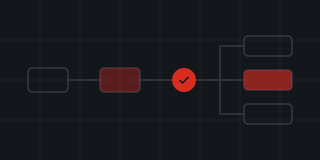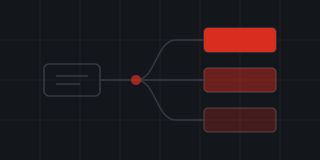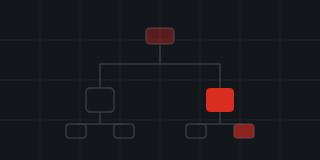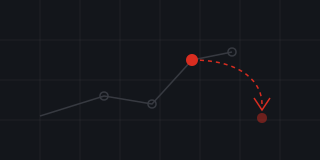
The scariest part of autonomous operations isn’t the deploy — it’s the moment after, when something looks slightly wrong and a system has to decide whether to keep going or back out. Foltrac’s rollback policy is the most carefully designed piece of the product.
The core rule: rollbacks must be boring. Foltrac never invents a recovery strategy at incident time. Every deploy records its inverse as a concrete, pre-validated plan before the first byte ships, so rolling back is replaying a plan that was checked when everyone was calm.
Detection is deliberately conservative. The policy engine watches error rates, latency distributions, and resource envelopes against baselines from the previous release — not absolute thresholds, which rot. A regression has to be sustained and attributable to the new release before the engine acts; transient noise gets logged, not acted on.
There’s also an asymmetry built in: the engine needs strong evidence to keep a suspect release, but only moderate evidence to roll it back. Reverting a good deploy costs you minutes; keeping a bad one costs you an incident. The math should reflect that.
Our agent systems research powers the coordination underneath — multiple regions roll back in dependency order, not alphabetically. The result across clouds: recovery that’s fast because it was planned, not because it was clever.